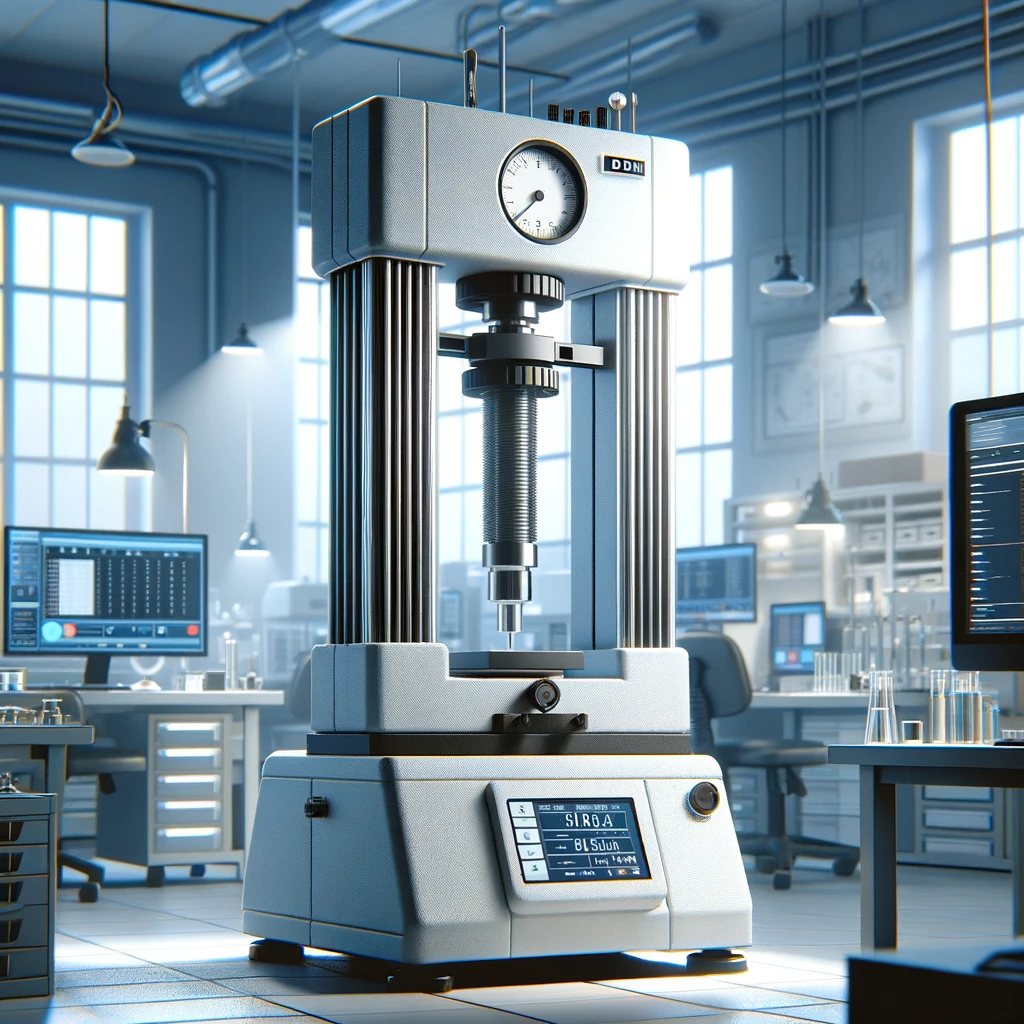
ISO 527

ISO 527

Understanding ISO 527-4:2023

Introduction

In the evolving landscape of material science, understanding the mechanical properties of composites is crucial for their effective application across various industries. The ISO 527-4:2023 standard offers a comprehensive framework for assessing the tensile properties of isotropic and orthotropic fiber-reinforced plastic composites, ensuring these materials meet the rigorous demands of modern engineering and design.

ISO 527

The Essence of ISO 527-4:2023

ISO 527-4:2023 outlines methods for determining tensile strength, modulus, and strain of fiber-reinforced plastics, providing a vital tool for material selection and quality assurance. By standardizing the test conditions, it allows for reliable comparison of materials and enhances the development of innovative composite applications.

Specimen Dimensions: The Foundation of Accurate Testing

The precision of tensile testing hinges on the specimen’s dimensions, which ISO 527-4:2023 details meticulously to ensure consistency and reliability in results. The standard specifies:

  • Shape and Dimensions: It prescribes shapes and exact dimensions for various specimen types, catering to a wide range of composite materials. For instance, it distinguishes between specimens for thermoplastics and thermosets, each tailored to reflect the material’s specific properties accurately.
  • Thickness Considerations: The thickness of the specimens, recommended between 2 mm to 10 mm, plays a crucial role in the test’s accuracy. It acknowledges the high fracture forces in continuous fiber-reinforced composites, suggesting a thickness of 2 mm for these materials to mitigate clamping pressures.
  • Gauge Length and Width: Key dimensions such as gauge length and width are defined to suit different types of composites, ensuring the application of uniform stress during testing.

Critical Test Procedures and Conditions

ISO 527-4:2023 describes the test environment, specimen mounting, and the speed of testing, among other parameters, to standardize the testing procedure. This ensures that the tensile properties are evaluated under controlled conditions, providing a true reflection of the material’s behavior under load.

Data Interpretation and Reporting

The standard mandates a detailed report comprising the specimen’s dimensions, test conditions, and the obtained mechanical properties. This comprehensive approach facilitates the analysis and application of test results, aiding in material comparison and selection processes.

Conclusion

ISO 527-4:2023 plays a pivotal role in the advancement of composite materials, offering a standardized approach to evaluating tensile properties. By meticulously defining specimen dimensions and testing conditions, it ensures the generation of reliable data, fostering innovation and ensuring safety in composite applications.


ASTM D 638

ASTM D 638

Exploring ASTM D 638: The Benchmark for Tensile Testing in Plastics

In the intricate field of materials engineering, the characterization of plastic materials holds paramount importance for a myriad of applications, ranging from aerospace components to everyday consumer products. Among the numerous standards that guide these evaluations, ASTM D 638 emerges as a critical benchmark for assessing the tensile properties of plastic specimens. This blog post delves into the essence of ASTM D 638, with a spotlight on the pivotal role of specimen dimensions in ensuring precise and meaningful test outcomes.

ASTM D 638

Understanding ASTM D 638

ASTM D 638, titled “Standard Test Method for Tensile Properties of Plastics,” is a meticulously crafted protocol developed by ASTM International. It aims to measure key tensile properties, including tensile strength, elongation, yield point, and modulus of elasticity. These properties are vital for determining how a material will perform under stress, making ASTM D 638 a cornerstone in the material selection and design process.

The Significance of ASTM D 638

The ability of a plastic material to withstand tensile forces is indicative of its durability, resilience, and overall performance. ASTM D 638 provides a uniform methodology to quantify these characteristics, enabling:

  • Informed Material Selection: Selecting the right material for specific load-bearing or flexibility requirements.
  • Rigorous Quality Assurance: Ensuring products meet industry standards and perform reliably in their intended applications.
  • Innovation in Material Science: Encouraging the development of new plastics with enhanced mechanical properties.

Zooming In: Specimen Dimensions

At the heart of ASTM D 638’s accuracy lies the detailed specification of specimen dimensions. The standard delineates several specimen types to accommodate different material thicknesses and testing needs. The most commonly employed, Type I specimen, is defined by precise dimensions:

  • Overall Length: 165 mm
  • Width in the Narrow Section: 13 mm
  • Thickness: This varies based on the material tested but typically ranges from 3.2 mm to 14 mm.

These dimensions are not arbitrary; they are crucial for achieving a uniform application of tensile forces during testing, ensuring that the measured properties are representative of the material’s inherent characteristics.

The Testing Procedure Unfolded

The ASTM D 638 test involves securing the specimen within a tensile test machine, gradually applying a pulling force until failure. The force and the specimen’s elongation are recorded throughout the test. These data points are then used to calculate the material’s tensile properties, painting a comprehensive picture of its mechanical behavior.

Decoding the Test Data

The insights garnered from ASTM D 638 testing are instrumental across the board:

  • For Designers: Empowering the creation of products that leverage the strengths of their material constituents.
  • For Manufacturers: Validating that materials conform to required specifications, ensuring reliability.
  • For Consumers: Benefiting from high-quality, durable products that have been tested for optimal performance.

In Conclusion

ASTM D 638 is more than just a testing standard; it’s a gateway to understanding the fundamental properties that make plastics so versatile and indispensable in modern engineering. The meticulous specification of specimen dimensions underlines the standard’s commitment to precision, making it an invaluable tool for anyone involved in the lifecycle of plastic materials.

ASTM D412

ASTM D 412

Exploring the Tensile Strength of Rubber: A Comprehensive Guide

ASTM D412

Introduction to Rubber’s Versatility

Rubber and elastomeric materials are celebrated for their remarkable versatility and durability, finding applications in industries ranging from automotive to healthcare. What gives rubber its unique set of properties, and how can these be quantified to ensure the material meets the specific needs of these diverse applications? The answer lies in understanding the tensile strength of rubber—a critical measure of its performance.

The Role of ASTM D 412 in Measuring Tensile Strength

ASTM D 412 is the gold standard for determining the tensile properties of vulcanized rubber and thermoplastic elastomers. This method meticulously evaluates tensile strength, elongation, and stress-strain behavior, offering a window into the material’s capabilities. However, it’s crucial to note that ASTM D 412 does not prescribe specific tensile strength values. Instead, it provides a framework for testing, leaving the actual values to be defined by the material’s composition and the test conditions.

The Significance of Tensile Strength

Tensile strength represents the maximum amount of tensile stress that a material can withstand before failure. For rubber, this metric is pivotal, dictating how well the material can maintain its integrity under stretch and stress. Whether it’s a tire enduring the rigors of the road or a medical device flexing within the human body, tensile strength ensures that rubber can perform reliably under pressure.

Navigating the Range of Tensile Strengths

Given the diversity of rubber compounds, tensile strength can vary significantly. Here’s a snapshot of average tensile strengths for some common types of rubber, showcasing the broad spectrum of performance:

  • Natural Rubber (NR): 20 to 30 MPa
  • Styrene-Butadiene Rubber (SBR): 2 to 30 MPa
  • Nitrile Rubber (NBR): 10 to 30 MPa
  • Ethylene Propylene Diene Monomer (EPDM): 8 to 20 MPa
  • Silicone Rubber: 5 to 12 MPa

These figures highlight the adaptability of rubber materials, engineered to meet the demands of specific applications through meticulous formulation and testing.

Conclusion: The Importance of Precision and Testing

The journey to selecting the right rubber material for any application begins and ends with precise testing and a deep understanding of tensile strength. ASTM D 412 serves as a crucial guide in this process, ensuring that materials are rigorously evaluated and chosen based on their ability to meet the demands of their intended use. By delving into the specifics of tensile strength, engineers and designers can unlock the full potential of rubber, creating products that not only perform exceptionally but also push the boundaries of what’s possible.

Material Testing Techniques

Material Testing Techniques

Material Testing Techniques

Advanced Material Testing Strategies: Key to Innovation and Quality Control

Introduction to Material Testing

In the realm of manufacturing, material testing stands as a cornerstone, ensuring products meet the rigorous standards of quality, durability, and safety required in today’s market. This process involves comprehensive evaluation of material properties under various conditions, aligning them with international standards and specifications. This blog aims to shed light on the paramount importance of material testing, explore standardized testing protocols, discuss specimen preparation, and unravel the intricacies of test report components, enhancing understanding of its critical role in product development and quality assurance.

The Critical Role of Material Testing

Material testing is not just a procedure; it’s the backbone of quality assurance in manufacturing. It equips manufacturers with essential data about the mechanical properties, composition, and performance of materials under different conditions. Whether it’s metals, polymers, or composites, testing these materials ensures they can withstand real-world applications, from automotive to aerospace engineering. This rigorous evaluation not only enhances product reliability but also fosters innovation, as testing results often lead to material improvements and the development of new, superior materials.

Standardized Testing Methods: The Foundation of Reliable Results

Adhering to standardized testing methods, such as those outlined by ASTM and ISO, is crucial for achieving reliable, comparable, and reproducible results. Techniques like tensile testing, impact testing, and hardness measurement are fundamental in determining a material’s suitability for specific applications. Each testing method follows a set procedure, including the type of equipment used, testing conditions, and the interpretation of results, ensuring consistency and reliability across the board.

Specimen Preparation and Dimensions: Paving the Way for Accurate Testing

The preparation of test specimens is a meticulous process, critical for obtaining accurate test results. Specimens must be prepared following specific standards, which dictate their dimensions, shape, and surface finish, to minimize variability and ensure the test results are solely reflective of the material’s properties. This preparation phase is pivotal in eliminating any external factors that could skew the test outcomes, ensuring the data collected is both accurate and relevant.

Deciphering Test Reports: A Comprehensive Overview

A test report is the culmination of the material testing process, offering a detailed account of the testing methods used, the results obtained, and their significance. These reports include critical information such as the material’s mechanical properties, its behavior under certain conditions, and how it compares to required standards. Understanding these reports is essential for manufacturers, as they form the basis for making informed decisions about material selection and product design.

The Future of Material Testing: Innovation and Technological Advancement

The future of material testing is marked by technological advancements and innovation. Cutting-edge technologies, such as digital microscopy, 3D scanning, and automated testing systems, are setting new standards for precision, efficiency, and accuracy in material testing. These advancements not only expedite the testing process but also offer deeper insights into material behaviors, paving the way for the development of materials with enhanced properties and performance.

Conclusion: Ensuring Excellence through Rigorous Testing

Material testing is an indispensable part of the manufacturing process, essential for certifying product quality, safety, and reliability. Through standardized testing methods, meticulous specimen preparation, and the detailed analysis of test reports, manufacturers can ensure their products stand up to the demands of their intended applications. As technology continues to evolve, so too will material testing techniques, driving innovation and ensuring that quality remains at the forefront of manufacturing excellence.

Differential Scanning Calorimetry (DSC)

Differential Scanning Calorimetry (DSC)

Differential Scanning Calorimetry (DSC)

Magic Behind Material Science with Differential Scanning Calorimetry (DSC)

Ever wondered how scientists unravel the mysteries locked within materials? Enter the world of Differential Scanning Calorimetry (DSC), a superhero tool in the realm of material science. This isn’t just another complicated scientific process; it’s a gateway to discovering what makes materials tick, melt, and transform.

Why DSC is a Big Deal

DSC might sound like a complex acronym, but it’s our go-to method for peeking into the thermal secrets of materials. From the medicines we take to the plastics that are everywhere around us, DSC plays a crucial role in understanding and improving them. It tells us about the heat required to change a material’s temperature compared to a reference. This info is gold for developing new materials and ensuring the quality of the ones we rely on daily.

The Steps to DSC Stardom

Imagine you’re a detective looking for clues. DSC is your magnifying glass for materials. Here’s how it works:

  1. Prep the Scene: Tiny samples of the material are meticulously prepared and placed in a DSC machine.
  2. Heat Things Up: As the temperature rises, the DSC machine records how the material reacts. Does it melt? Does it crystallize? This is where the action happens.
  3. Analyze the Clues: The machine spits out data that tell us the material’s story through its thermal behavior.

The Impact of DSC Discoveries

The insights gained from DSC can be revolutionary. They influence everything from how drugs are formulated to make them more effective, to designing materials that can withstand extreme temperatures. It’s about making our world safer, healthier, and more sustainable.

Decoding the Data

A DSC analysis gives us a graph that might look like squiggly lines at first glance, but to a trained eye, it’s a treasure map. It reveals critical transitions like melting points and crystallization, which are key to material science breakthroughs.

Beyond the Lab Bench

While DSC might be rooted in research and development, its impact stretches far and wide. It’s a testament to how understanding the fundamentals can lead to innovations that touch every aspect of our lives.

Wrapping It Up

Differential Scanning Calorimetry might just be one of many techniques in material science, but its contributions are monumental. It’s about looking beneath the surface and discovering the potential within materials to innovate and improve our daily lives. So the next time you come across a material—be it the packaging of your food, the fabric of your clothes, or the casing of your phone—remember, DSC might have played a part in its journey to you.

Differential Scanning Calorimetry (DSC)
Thermogravimetric Analysis (TGA)

Thermogravimetric Analysis (TGA)

Thermogravimetric Analysis (TGA)

Thermogravimetric Analysis (TGA) is a critical technique in the field of material science, offering invaluable insights into the thermal decomposition and stability of various materials. This technique measures the mass of a sample over time as it is heated, cooled, or held at a constant temperature. It is instrumental in characterizing materials for research, quality control, and manufacturing processes.

Overview of Thermogravimetric Analysis

TGA is a thermal analysis method that measures changes in the weight of a material as a function of temperature or time. This analysis is essential for understanding the composition, thermal stability, and moisture content of materials. It is widely applicable in analyzing polymers, pharmaceuticals, and inorganic substances.

Importance of TGA in Material Characterization

Understanding the thermal behavior of materials is crucial for their application in various industries. TGA provides detailed information on:

  • Thermal stability and decomposition temperatures.
  • Moisture and volatiles content.
  • Composition, including filler content in composites.

Standardized Approach to TGA

Adhering to international standards such as ASTM E1131 and ISO 11358 ensures the reliability and reproducibility of TGA results. These standards define the procedure for conducting TGA, including the heating rate, atmosphere, and sample preparation guidelines.

Preparing Samples for TGA Analysis

Proper sample preparation is key to obtaining accurate TGA data. Samples are typically in the milligram range and placed in pans that can withstand high temperatures without reacting with the sample.

Interpreting TGA Data

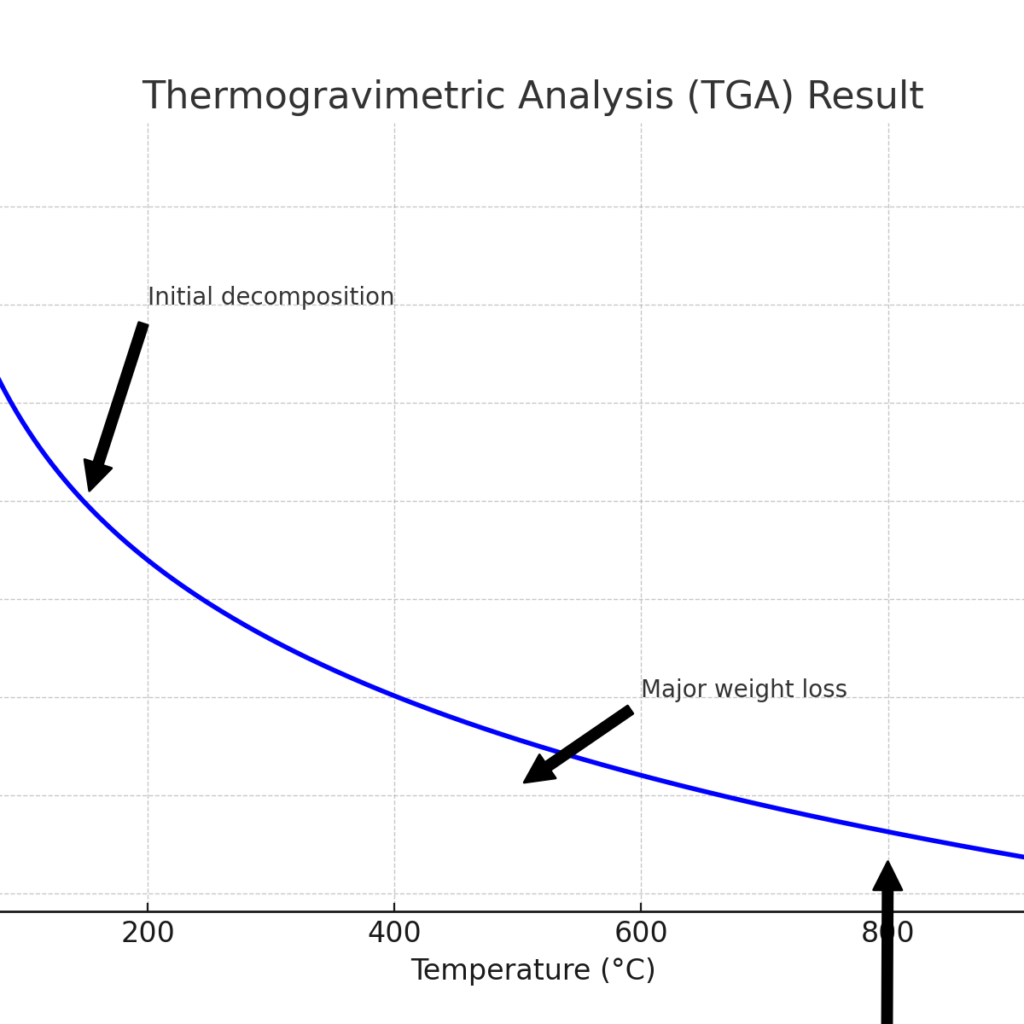
A TGA curve provides a graphical representation of mass loss as a function of temperature. Analyzing these curves allows for the identification of various thermal events, such as:

  • Decomposition temperatures.
  • Thermal stability ranges.
  • Residual mass, indicating the amount of filler or non-volatile components.

Broad Applications of TGA

The versatility of TGA makes it a valuable tool across multiple fields, including:

  • Polymer science for understanding polymer decomposition and stability.
  • Pharmaceutical research for analyzing drug purity and stability.
  • Inorganic chemistry for studying the thermal properties of metals and minerals.

Conclusion

TGA is an indispensable technique in material science, offering detailed insights into material thermal properties. It plays a crucial role in the development, testing, and quality assurance of materials across various industries.

TGA_Result_Graph
FTIR

FTIR Analysis

Introduction

Imagine holding a piece of history in your hands, analyzing the composition of a new drug that could save lives, or ensuring the food on your plate is safe to eat. What if you could uncover the secrets held by a painting that’s centuries old or ensure the materials used in your favorite products are of the highest quality? This isn’t just the stuff of imagination—it’s the reality made possible through the lens of Fourier Transform Infrared (FTIR) Analysis.

Importance of FTIR Analysis

FTIR analysis plays a crucial role in various industries due to its versatility and non-destructive nature. It can provide detailed information about the molecular structure and composition of materials without altering them. This part of the blog will delve into the significance of FTIR in ensuring product quality, environmental safety, and advancing scientific research.

Applications of FTIR Analysis

FTIR is widely used in pharmaceuticals, environmental science, forensic analysis, polymers, and chemicals manufacturing, among other fields. This section will highlight some key applications of FTIR analysis, illustrating its impact on product development, quality control, and research. Examples will include identifying contaminants in food products, analyzing polymers’ composition, and detecting hazardous substances in environmental samples.

Benefits of FTIR Analysis

The benefits of using FTIR analysis include its speed, accuracy, and the minimal sample preparation required. This part of the blog will discuss how FTIR analysis saves time and resources in research and development, helping scientists and industries make informed decisions quickly.

FTIR
FTIR

Conclusion

The technical advancements and broad applicability of FTIR analysis underscore its value in modern scientific research and industrial applications. As technology progresses, FTIR spectroscopy will continue to evolve, offering deeper insights into the molecular composition of materials and fostering innovations across a wide range of disciplines.

SEM

Scanning Electron Microscope

SEM Analysis

Home >SEM Analysis

SEM

At Kiyo R&D Center & Laboratory, we delve deep into the fabric of materials with our state-of-the-art Scanning Electron Microscopy (SEM) analysis, revealing the unseen intricacies that dictate their properties and behaviors. Our SEM technology offers unprecedented insights into the microstructure of materials, enabling high-resolution imaging and elemental analysis with applications spanning from quality control and research and development to failure analysis. This microscopic examination is crucial for innovating new materials, improving existing products, and solving complex material failures, thereby providing our clients with the knowledge to make informed decisions and maintain a competitive edge in their respective fields.

SEM
SEM

Collaborating with Kiyo R&D means accessing a world of microscopic detail and expert analysis, where our advanced SEM capabilities meet comprehensive expertise. Our team not only captures detailed images at magnifications up to 100,000x but also interprets these images to offer actionable insights, translating complex data into tangible solutions. By partnering with us, organizations across various industries can unlock the potential of their materials, paving the way for breakthroughs in product development and material science, ultimately transforming the invisible into the foundational stones of innovation and quality.

DSC

dsc

DSC

Understanding Differential Scanning Calorimetry: A Comprehensive Guide

Differential Scanning Calorimetry (DSC) is a pivotal thermal analysis technique used in science and industry to measure the temperatures and heat flows associated with thermal transitions in a material. This innovative method provides invaluable insights into the physical and chemical properties of substances, such as polymers, pharmaceuticals, and foods. In this comprehensive guide, we’ll delve into the fundamentals of DSC, its applications, and why it’s a critical tool in material characterization.

What is Differential Scanning Calorimetry (DSC)?

Differential Scanning Calorimetry is an analytical technique that measures the difference in the amount of heat required to increase the temperature of a sample and reference as a function of temperature. Both the sample and reference are maintained at nearly the same temperature throughout the experiment. The reference is typically a material with no transition over the temperature range of interest. The principle behind DSC is straightforward: it monitors heat effects associated with phase transitions and reactions as a function of temperature.

How Does DSC Work?

The core of the DSC operation involves heating or cooling a sample and an inert reference at a controlled rate. As the temperature changes, the sample may undergo physical or chemical changes that involve a change in enthalpy (heat content). These changes can include melting, crystallization, glass transitions, and chemical reactions. The DSC instrument measures the difference in heat flow between the sample and the reference, which is then plotted against temperature to create a DSC curve. This curve provides critical information about the thermal transitions in the sample.

Applications of Differential Scanning Calorimetry

DSC is a versatile technique with a wide range of applications across various fields:

  • Pharmaceuticals: Characterization of drug substances, including polymorphism, melting point determination, and stability studies.
  • Polymers: Determination of crystallinity, glass transition temperatures, and material compatibility.
  • Food Science: Analysis of fats and oils, protein denaturation, and gelatinization of starch.
  • Environmental Science: Studying thermal decomposition and oxidative stability of materials.

Why is DSC Important?

DSC is indispensable in research and quality control because it provides vital information that cannot be obtained by other means. It helps in:

  • Material Development: Optimizing formulations and processing conditions.
  • Quality Control: Ensuring consistency and performance of materials.
  • Regulatory Compliance: Providing necessary data for regulatory submissions.

Visualizing DSC: An Illustrative Approach

To better understand the DSC process and its outcomes, let’s visualize a typical DSC curve. This curve represents a hypothetical material undergoing a melting transition followed by a crystallization on cooling.

  • Onset of Melting: The point where the sample starts to melt.
  • Peak of Melting: The temperature at which the melting is most significant.
  • Crystallization: Observed upon cooling, indicating the formation of a crystalline structure from the liquid phase.
DSC

Conclusion

Differential Scanning Calorimetry is a cornerstone technique in the analysis of thermal properties of materials. Its ability to provide detailed insights into material behavior under thermal stress makes it an invaluable tool in both research and industry. Understanding DSC allows scientists and engineers to innovate and ensure quality in their materials, contributing significantly to advancements in various fields.

Incorporating DSC into your material analysis regime opens up a world of possibilities for characterization and development. Whether you’re in pharmaceuticals, polymers, food science, or environmental research, DSC offers the precision and reliability needed to push the boundaries of what’s possible with materials.

Tensile testing

Material Testing Service

Material Testing Service

Home > Single Post

Tensile testing

Discover why material testing labs are pivotal in driving innovation and ensuring product quality across industries. From aerospace engineering to consumer electronics, learn how Kiyo’s state-of-the-art material testing services set the standard for excellence.

Material testing isn’t just a step in the manufacturing process; it’s the backbone of product reliability and safety. Explore the importance of material testing in developing products that meet and exceed global standards and consumer expectations.

Dive into what makes Kiyo’s material testing services stand out in a crowded field. With cutting-edge technology, a team of expert engineers, and a customer-centric approach, Kiyo leads the way in material analysis and testing solutions.

Learn about Kiyo’s wide range of advanced material testing capabilities, from tensile and flexural strength tests to environmental and chemical resistance assessments. Discover how our ISO-certified labs ensure your products are built to last.

Choosing the right material testing lab can make all the difference in your product’s success. Find out why Kiyo is the preferred partner for businesses seeking to innovate responsibly and deliver products that stand the test of time.