Rubber Testing Lab in Chennai — ASTM & ISO | Kiyo R&D Lab
Rubber Testing Lab in Chennai — Kiyo R&D Lab
Rubber components fail quietly — a seal that hardens, a gasket that cracks, a tyre compound that wears too fast. By the time the symptom shows up in the field, the cost is already high. That is why manufacturers across Chennai turn to Kiyo R&D Lab to verify the physical and ageing properties of their rubber and elastomer products before they ship.
From hardness and tensile strength to compression set, abrasion, and accelerated ageing, we run the full range of rubber tests on calibrated equipment to recognised ASTM, ISO, and IS methods. The result is clear, defensible data that your quality, design, and compliance teams can act on with confidence.
Rubber and elastomers behave very differently from metals and plastics. They flex, recover, harden with age, swell in oils, and degrade under heat, ozone, and sunlight. A compound that performs perfectly on day one can lose its sealing force or split within months if its properties are not verified. Testing catches these weaknesses before they reach the customer.
For manufacturers of seals, gaskets, hoses, tyres, footwear, and automotive parts, rubber testing is the proof that a product will hold up in real service conditions. It also satisfies customer specifications, supports certification, and gives R&D teams the data to validate new compounds or supplier changes with confidence.
Our Rubber Testing Services
Kiyo R&D Lab tests natural rubber, synthetic elastomers, and finished rubber products across a wide range of properties, with documented procedures at every step. Below are the categories we test most often.
Hardness Testing
Shore A and Shore D durometer measurement to verify the firmness of rubber compounds.
Tensile & Elongation
Tensile strength, modulus, and elongation at break for vulcanised and thermoplastic rubber.
Compression Set
How well a seal or gasket recovers its shape after prolonged compression and heat.
Accelerated Ageing
Heat ageing in air ovens to predict how properties change over the product’s life.
Abrasion Resistance
Wear and material loss testing for soles, tyres, rollers, and high-friction parts.
Density & Swelling
Specific gravity and fluid/oil resistance to confirm compound behaviour in service.
Detailed Breakdown of Key Tests
✔Hardness (Shore A/D): measures resistance to indentation, the most common quality check for rubber firmness.
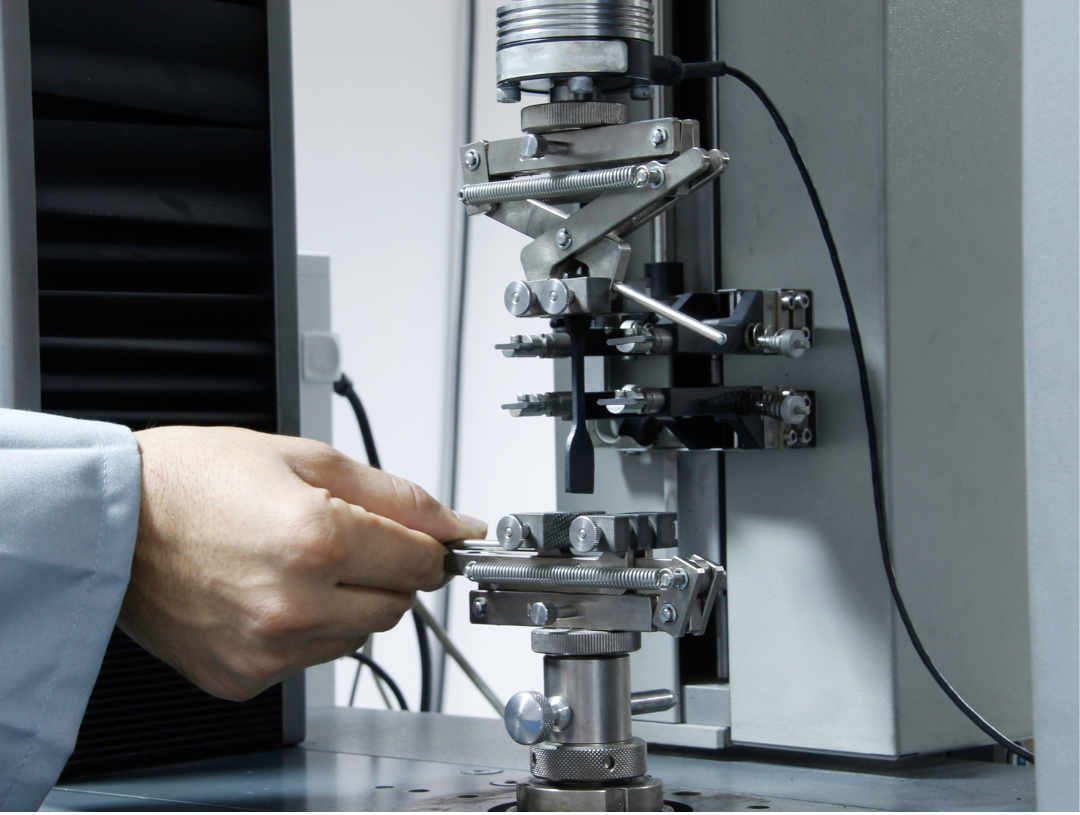
✔Tensile Strength & Elongation: the force needed to break the rubber and how far it stretches first — core indicators of compound quality.
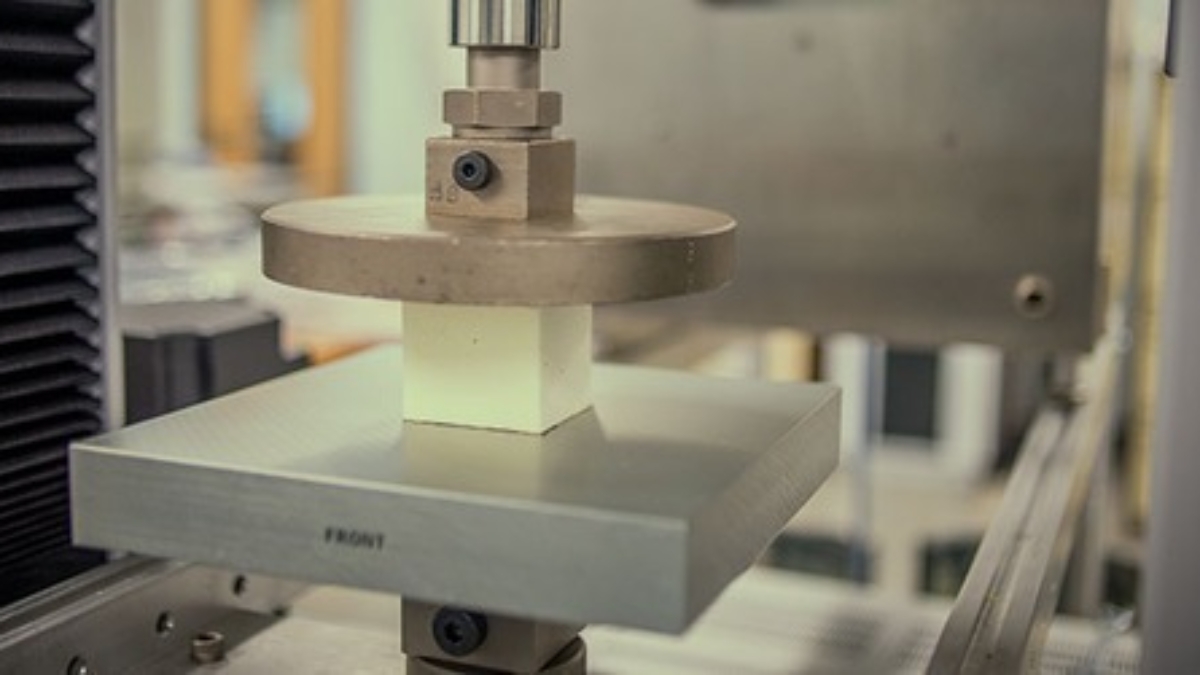
✔Compression Set: the permanent deformation left after a sample is held compressed — critical for seals and gaskets.
✔Accelerated Heat Ageing: exposes samples to elevated temperature to estimate long-term durability in a short time.
✔Abrasion Resistance: quantifies material loss under controlled rubbing, predicting wear life of soles and tyres.
Testing Standards We Follow
Trustworthy results depend on traceable methods. We test to internationally recognised rubber standards so your reports are accepted by customers, auditors, and certification bodies alike.
ASTMISOIS (BIS)
Standard
What It Covers
Typical Use
ASTM D412
Tensile strength and elongation of vulcanised rubber
Seals, gaskets, general rubber goods
ASTM D2240
Durometer hardness (Shore A and Shore D)
Firmness check for all rubber compounds
ASTM D395
Compression set of rubber
Sealing and gasket applications
ASTM D573
Accelerated heat ageing in an air oven
Durability and shelf-life prediction
ISO 37
Tensile stress-strain properties of rubber
International compliance for elastomers
ISO 7619-1
Indentation hardness using a durometer
Hardness for export-grade products
If your specification calls for a standard not listed here, just ask — our team will confirm the method and specimen requirements before testing begins.
Serving Chennai & Beyond
Conveniently located for manufacturers across Chennai and the wider Tamil Nadu industrial belt, Kiyo R&D Lab makes sample drop-off, testing, and reporting simple. Reach out and we will guide you on sample preparation and turnaround.
📍 Kiyo R&D Lab — Chennai
Our main testing facility, serving rubber and elastomer manufacturers across Chennai, Sriperumbudur, Ambattur, and surrounding industrial areas with fast, reliable testing.
Reliable rubber data protects your products, your reputation, and your customers. With calibrated equipment, standards-compliant methods, and clear reporting, Kiyo R&D Lab gives Chennai’s manufacturers the dependable results they need to design, certify, and ship with confidence.
Ready to test your rubber or elastomer samples? Reach out today and our team will guide you from sample preparation to final report.
We cover hardness (Shore A/D), tensile strength and elongation, compression set, accelerated heat ageing, abrasion resistance, density, and swelling. If you have a specific requirement, call us and we will confirm whether it fits our scope.
What types of rubber products can you test?
Natural rubber, synthetic elastomers, and finished products such as seals, gaskets, O-rings, hoses, footwear soles, tyres, and automotive components. Both raw compounds and finished parts are welcome.
How long does rubber testing take?
It depends on the tests involved — hardness and tensile checks are quick, while accelerated ageing and compression set need fixed exposure times. Share your requirement on WhatsApp and we will confirm an expected timeline with your quote.
Which standards do you test to?
We follow widely recognised rubber standards including ASTM D412 and ISO 37 for tensile, ASTM D2240 and ISO 7619-1 for hardness, ASTM D395 for compression set, and ASTM D573 for heat ageing. Other standards can be accommodated on request.
How should I prepare my rubber samples?
Sample size and quantity depend on the tests and standards being applied. Contact us before sending samples and our team will guide you on the right dimensions, number of specimens, and any conditioning needed for accurate results.
How do I get a quote?
The fastest way is to message us on WhatsApp with your material type, the tests or standard you need, and the number of samples, or call us directly. We will respond with pricing and turnaround so you can plan with confidence.
our Quality Assurance Partner: Why Kiyo R&D Lab is the Leading Product Testing Lab in India
When you launch a new product—be it an EV component, a sophisticated consumer appliance, or a simple plastic enclosure—you aren’t just selling a device; you are selling a promise. A promise of safety, durability, and reliability. If that product fails unexpectedly in the field, the cost isn’t just a replacement fee; it’s a damaged brand reputation, costly recalls, and lost future revenue.
In India’s competitive and rapidly expanding manufacturing ecosystem, that promise must be backed by science. That’s where the meticulous precision of a world-class testing facility becomes absolutely indispensable. If you are looking for comprehensive, NABL-accredited solutions, Kiyo R&D Lab is the premier product testing lab in India, built to ensure your components meet and exceed the toughest global standards.
What Exactly is Product Testing, and Why Does it Matter Now More Than Ever?
Product testing is the rigorous process of subjecting a finished item, material, or component to simulated real-world stresses to verify its performance, safety, and compliance before it hits the market. It answers the fundamental question: Will this product survive its intended environment for its intended lifespan?
The need for high-quality product testing lab in India has surged due to several key factors:
Global Supply Chain Demands: Indian manufacturers are increasingly supplying critical components to international OEMs (Original Equipment Manufacturers). This requires strict adherence to international standards like ASTM, ISO, and IEC.
Climate Extremes: Products must endure India’s unique environmental challenges—high humidity, extreme heat, heavy dust, and monsoon conditions.
Consumer Expectations: Modern consumers demand longevity. A product that fails prematurely, especially electronics or automotive parts, receives immediate negative feedback, often magnified by social media.
Regulatory Compliance: Certification bodies (BIS, CE, etc.) mandate specific safety and durability tests before products can legally be sold.
The Kiyo R&D Lab Difference: Integrated Testing Solutions
What sets Kiyo R&D Lab apart as a leading product testing lab in India is our ability to provide integrated characterization. We don’t just run one test; we offer a holistic view of your material, ensuring all critical failure modes are addressed.
Pillar 1: Mechanical Durability (Testing the Body)
This testing focuses on how your material handles physical stress and cyclic wear.
Fatigue Testing: The ultimate test of lifespan. We subject components to millions of repeated load cycles to predict exactly when and how they will fail due to cumulative wear—the number one cause of structural failure in engineering.
Tensile & Impact Testing: Measuring a material’s fundamental strength (the force required to stretch or break it) and its toughness (its ability to absorb a sudden blow without shattering). Essential for plastic enclosures and metal brackets.
Creep Resistance Testing: Measuring how materials (especially plastics and metals) slowly deform or “stretch” over a very long time under constant load, often at high temperatures—crucial for power plant or engine components.
Scratch & Abrasion Testing: Verifying the aesthetic longevity of coatings and surfaces on consumer goods, optics, and automotive interiors.
Pillar 2: Thermal & Environmental Resilience (Testing the Environment)
This testing ensures your product can withstand the demanding climates it will encounter.
Environmental Chambers: Simulating extreme conditions like rapid temperature cycling (thermal shock), high humidity, and prolonged high heat to test electronic seals and polymer stability.
Corrosion Resistance Testing: Using advanced chambers for Salt Spray Testing (ASTM B117) and Cyclic Corrosion Testing (CCT) to predict how long metal components and their protective coatings will survive in coastal or polluted environments.
Thermal Stability Analysis (TGA/DSC): Analyzing the polymer from a fundamental level to determine its exact composition (filler percentage, moisture) and its maximum operational temperature before thermal degradation begins.
Why Manufacturers Trust Kiyo R&D Lab
Choosing a product testing lab in India requires trust, precision, and demonstrable competence. Kiyo R&D Lab provides all three through its operational foundation:
1. NABL / ISO 17025 Accreditation: Global Confidence
Kiyo R&D Lab is NABL (National Accreditation Board for Testing and Calibration Laboratories) accredited. This is the gold standard for testing laboratories, guaranteeing that our procedures, equipment calibration, and final reports are rigorously checked, traceable, and accepted globally. Your report from Kiyo is instantly credible, simplifying export and regulatory compliance.
2. Expert Consultation, Not Just Data
We employ seasoned specialists—material scientists, metallurgists, and polymer chemists—who understand the root causes of material failure. We don’t just hand you a pass/fail number; we provide Failure Analysis and Consultation, explaining why a component failed and guiding your design team toward the optimal material or processing solution.
3. Efficiency and Agility
We understand that time to market is vital. Kiyo R&D Lab is structured to offer efficient turnaround times without ever compromising the precision required by our accreditation. This agile service model supports fast-paced R&D cycles.
4. Tailored Solutions for Indian Industry
Kiyo R&D Lab is ideally positioned to serve India’s unique industrial needs, from testing high-wear agricultural machinery components to verifying the extreme temperature resistance required by domestic space and defense projects. We align testing protocols with both Indian and international standards (BIS, ASTM, ISO).
Conclusion: Mitigate Risk. Guarantee Quality.
In today’s market, quality is not optional; it’s the price of entry. Relying on guesswork for durability will eventually lead to product failure and brand erosion.
By partnering with Kiyo R&D Lab, you secure more than just a test report; you gain a commitment to structural integrity, functional reliability, and customer confidence. Make the strategic investment in science today, and ensure your product’s success tomorrow.
Ready to certify your product’s endurance? Contact Kiyo R&D Lab, the trusted product testing lab in India, to schedule your full qualification testing.
In today’s competitive product landscape, quality and reliability are no longer optional—they’re essential. Especially when working with rubber and elastomeric materials, slight variations in compound, process, or aging can drastically affect performance, longevity, and safety. Whether you’re manufacturing seals, hoses, gaskets, O‑rings, vibration mounts, or custom molded rubber parts, you need robust testing to prove that your components will stand up to real‑world demands.
That’s where Rubber Lab Testing Services in India – Kiyo R&D Lab comes in. If you’re searching for an Indian partner with deep technical know‑how, certified infrastructure, and a client-focused approach, this blog will guide you through:
Why rubber testing is so critical
The major tests and methodologies
The landscape of rubber testing in India
What makes Kiyo R&D Lab a compelling choice
How to get the most value from your testing
By the end, you’ll see how positioning your service as “Rubber Lab Testing Services in India – Kiyo R&D Lab” helps you connect with clients who care about precision, regulatory compliance, and material integrity.
Body
1. Why Rubber Testing Matters
1.1 The Nature of Rubber: Complex & Sensitive
Rubber is a polymeric, viscoelastic material—its performance properties depend not just on composition but on how it’s processed, aged, and stressed over time. A tiny impurity, an inconsistent cure, or slight variation in filler dispersion can lead to failure. Without proper testing, hidden flaws may haunt your final product.
1.2 Real Risks from Poor Rubber Quality
Leakage or sealing failure — in gaskets, O‑rings, or seals
Material degradation or cracking — under heat, ozone, UV, or chemical exposure
Loss of mechanical performance — reduced tensile strength, elongation, tear resistance
Unexpected aging or hardening — making parts brittle
Noncompliance with customer or regulatory specs
Given these risks, rigorous testing becomes your shield against warranty claims, recalls, and reputation damage.
1.3 Business & Regulatory Drivers
Many industries demand compliance with standards (ASTM, ISO, BIS)
When exporting, test reports from NABL‑accredited labs are often required
Testing helps in selecting the right rubber grade and design early
It supports failure analysis and continuous improvement
In short, rubber testing is not just a checkbox—it’s a strategic tool.
2. Essential Rubber Lab Tests & Methods
Below is a rundown of key tests commonly performed in rubber labs. A reliable lab should be able to offer this suite or customize based on your needs.
2.1 Mechanical & Physical Tests
Tensile Strength & Elongation (e.g. ASTM D412) — measures how far rubber can stretch before breaking
Tear Resistance (ASTM D624) — ability to resist propagation of a cut or notch
Hardness Measurement (Shore A, Shore D, IRHD) — how firm the rubber is under indentation
Compression Set — how well the rubber recovers after compressive stress (ASTM D395)
Creep & Stress Relaxation — long‑term deformation under load
Abrasion / Wear Resistance — how rubber resists surface wear
2.2 Aging & Durability Tests
Heat Aging / Thermal Aging — exposing samples to elevated temperatures and rechecking properties
Ozone or UV Exposure — evaluating cracking or surface damage in ozone/UV environments
Cold Temperature Testing / Low‑Temperature Flexibility
Cyclic Fatigue / Dynamic Fatigue — repeated loading and unloading to simulate real usage
2.3 Chemical & Environmental Tests
Swelling / Solvent Resistance — how rubber absorbs or resists fluids like oils, fuels, solvents
Chemical Resistance — exposure to acids, bases, corrosive media
Weatherability / Accelerated Weathering
Aging in Humidity or Water
2.4 Analytical / Composition Tests
Ash / Filler Content / Inorganic Content — via TGA or ignition methods
FTIR / Infrared Spectroscopy — to identify polymer type or contaminants
Differential Scanning Calorimetry (DSC) — thermal transitions, glass transition temperature
If you’re using rubber in electrical insulation or sealing around electronics, labs may also offer dielectric strength, resistivity, breakdown voltage, etc.
3. The Indian Rubber Testing Landscape
Knowing the current environment helps in choosing the right partner.
3.1 Accreditation & Trust
In India, the NABL (National Accreditation Board for Testing & Calibration Laboratories) is the benchmark for lab competence (ISO/IEC 17025) Wikipedia. A lab that is NABL‑accredited commands much greater trust—especially when dealing with regulators, OEMs, or overseas clients.
Kiyo R&D Lab’s website shows that they serve the “Plastics & Rubber” domain as part of their core testing services. Kiyo R&D Center and Laboratory
3.2 Existing Players & Competitors
FAN Services offers NABL‑accredited rubber testing, from simple grade ID to advanced material analysis. fan-indiatestinglabs.com
Vichar Technology provides tests like tensile, hardness, compression set, swelling, filler content, aging etc. vichartechnology.com
HASETRI (Hari Shankar Singhania Elastomer & Tyre Research Institute) is a high‑profile independent rubber & tyre R&D & test center. hasetri.com
The Auto Cluster Rubber Polymer Lab (RPL) in Pune is a recognized NABL‑ISO/IEC 17025 lab for polymer and rubber materials. autoclusterpune
3.3 Challenges & Opportunities
Geographic convenience: clients often prefer labs closer to their production sites to reduce logistics risks
Equipment sophistication: not all labs have advanced instrumentation like DSC, TGA, fatigue test rigs
Turnaround time: competition is on speed, quality, and adaptability
Custom & rare tests: the ability to develop or execute non‑standard or hybrid tests is a differentiator
Given this, a lab that combines core capabilities, accreditation, and customer orientation can stand out.
4. Why Choose Rubber Lab Testing Services in India – Kiyo R&D Lab
Let’s zoom into what Kiyo R&D Lab brings to the table and how it can be your trusted partner.
4.1 Overview & Expertise
Kiyo R&D Lab presents itself as a materials and product testing laboratory with services in plastic, rubber, metal, coatings, etc. Kiyo R&D Center and Laboratory+1
They list “Plastic and Rubber Testing Laboratory” as part of their domain, indicating they have domain competence. Kiyo R&D Center and Laboratory+1
Their public-facing pages mention regional operations (e.g. a page for Rubber Testing Lab in Chennai). Kiyo R&D Center and Laboratory
Their profile on LinkedIn also highlights “Rubber Testing” among services. LinkedIn
Hence, Kiyo is already positioned to cater to rubber testing demands.
4.2 Key Strengths & Differentiators
Multidisciplinary capabilities — because they also handle mechanical, thermal, electrical, chemical, and degradation testing, clients can combine multiple test scopes under one roof
Local presence + national reach — less logistic overhead and faster sample turnaround
Customization — offering “customer / custom standard” testing suggests flexibility in test protocols Kiyo R&D Center and Laboratory
Brand & SEO alignment — using the phrase Rubber Lab Testing Services in India – Kiyo R&D Lab helps clients searching specifically for rubber testing in India find you
Credibility potential — though their site doesn’t explicitly list NABL accreditation for every test, their emphasis on “high quality” and “testing laboratory” suggests they operate in a regulated environment Kiyo R&D Center and Laboratory
4.3 What to Require from Kiyo
When engaging Kiyo, here’s what you should ask:
Accreditation status — for the specific rubber test(s) you need
Test equipment details — e.g. type of fatigue or aging chambers, thermal analyzers, test frames
Test methods / standards used — ASTM, ISO, BIS, or custom
Turnaround times & reporting format — raw data, stress‑strain curves, pass/fail conclusions
Failure analysis support — root cause investigation if your sample fails
Follow-up or re‑test policy
By partnering this way, you’re not just buying a test — you’re getting actionable insight.
5. Best Practices for Leveraging Rubber Lab Testing
To extract maximum benefit from rubber testing, apply these practices:
5.1 Start Test Planning Early
Don’t wait until your prototype is fully built. Bring the lab in early during material and compound selection to catch issues before tooling or mass production.
5.2 Provide Relevant Context & Use Conditions
Tell the lab your real-world environment—temperature extremes, chemicals, loading, dynamic stresses—so they can simulate meaningful conditions.
5.3 Use Representative Samples & Fixtures
Test realistic parts (or representative sections). Use fixtures that mimic your actual mountings or boundary conditions, not just strips.
5.4 Monitor & Record Thoroughly
Have the lab capture full test curves, raw data, temperature logs, cycles, and any anomaly events. Don’t settle for summary “pass/fail.”
5.5 Iterative Feedback Loop
When a test fails or shows degradation, use the data to refine compound, design, or process. Re‑test to validate improvements. Over time, build a knowledge base.
5.6 Use Comparative / Benchmark Tests
If possible, test competitor or baseline materials side by side to benchmark performance. Sometimes relative performance is more meaningful than absolute numbers.
Conclusion
Rubber is a demanding material—its performance extends beyond mere shape, hinging on chemistry, compounding, processing, and aging dynamics. That’s why Rubber Lab Testing Services in India – Kiyo R&D Lab isn’t just a marketing phrase—it encapsulates a promise: you’ll get precise, credible, localized testing for your rubber parts.
When you choose Kiyo, you gain an integrated lab partner capable of mechanical, chemical, thermal, degradation, and analytical testing. Always confirm accreditation, protocol depth, turnaround, and flexibility before placing a test. Use the data you get back not as a report card but as a design tool—feeding insights back into your material and design development.