
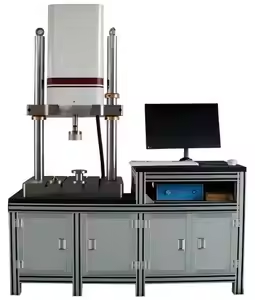
Most material failures don’t happen because a material is “weak” on paper. They happen because the material behaves differently over time, temperature, and loading conditions than expected. A plastic that passes tensile testing may creep under constant load. A rubber that looks perfect at room temperature may stiffen or soften drastically in service. A coating that seems fine initially may lose damping ability and crack later.
This is exactly where Dynamic Mechanical Analysis (DMA) becomes critical.
If you’re searching for the dynamic mechanical analysis test – Kiyo R&D LAB, you’re likely not looking for basic strength numbers. You’re looking to understand how a material actually behaves in real-world conditions.
At Kiyo R&D LAB, DMA testing is used as a material behavior study tool, not just a checkbox test.

What Is Dynamic Mechanical Analysis (DMA)?
Dynamic Mechanical Analysis is a technique used to measure the viscoelastic properties of materials as a function of:
- Temperature
- Time
- Frequency
- Applied dynamic stress or strain
Unlike static tests, DMA applies a small oscillating force to a sample and measures how the material responds. This response tells us how much energy is:
- Stored (elastic behavior)
- Lost (viscous behavior)
In short, DMA shows how a material behaves between solid and liquid states, which is where most polymers, rubbers, and composites actually operate.
Why DMA Is More Insightful Than Conventional Mechanical Tests
Let’s be direct:
A single tensile or flexural value does not tell the full story.
DMA reveals things that standard tests cannot:
- Stiffness change with temperature
- Damping behavior
- Glass transition temperature (Tg)
- Long-term performance trends
- Material stability under cyclic loading
If your product experiences:
- Vibration
- Repeated loading
- Temperature variation
- Dynamic stress
Then DMA data is not optional — it’s essential.
Key Parameters Measured in a DMA Test
A proper dynamic mechanical analysis test focuses on three core outputs:
1. Storage Modulus (E′)
- Represents elastic or energy-storing behavior
- Indicates stiffness of the material
- Drops sharply around glass transition
2. Loss Modulus (E″)
- Represents energy dissipation as heat
- Indicates internal friction and molecular motion
3. Tan Delta (tan δ)
- Ratio of loss modulus to storage modulus
- Measures damping characteristics
- Peak tan δ often correlates with Tg
These parameters together explain how and why a material changes behavior under different conditions.
Materials Commonly Tested Using DMA
At Kiyo R&D LAB, DMA testing is routinely performed on:
- Thermoplastics (PP, PE, PVC, ABS, Nylon)
- Thermosets (epoxy, polyester, phenolic)
- Rubber and elastomers (NR, SBR, EPDM, silicone)
- Polymer blends
- Fiber-reinforced composites
- Adhesives and sealants
- Coatings and films
If your material is polymer-based and performance varies with temperature or loading, DMA testing applies.
Dynamic Mechanical Analysis Test – Practical Applications
DMA is widely used across industries because it answers practical performance questions, such as:
- At what temperature does my material soften?
- Will this polymer damp vibration or transmit it?
- How stable is this composite under cyclic stress?
- Is one formulation better than another?
- Why does this batch behave differently from last month?
Typical applications include:
- Material selection and comparison
- R&D formulation optimization
- Quality control and batch consistency checks
- Failure analysis
- Product validation for real-use conditions
DMA bridges the gap between lab data and field performance.
Glass Transition Temperature (Tg): Why DMA Is the Gold Standard
Many materials list a Tg value — but not all Tg values are created equal.
DMA is considered one of the most sensitive methods for determining Tg because:
- It detects molecular mobility changes
- It shows transitions clearly through modulus drop and tan δ peak
- It reflects functional behavior, not just thermal change
For polymers and rubbers, Tg determined by DMA is often more application-relevant than values obtained from purely thermal techniques.
Common Mistakes in DMA Testing (And Why Results Go Wrong)
Here’s where many labs and users go wrong:
- Wrong test mode (tension, bending, shear not selected properly)
- Incorrect sample dimensions or preparation
- Ignoring frequency dependence
- Comparing DMA data from different test conditions
- Reporting numbers without interpretation
DMA data without context is just curves.
DMA data with proper method discipline becomes engineering insight.
Why Choose Kiyo R&D LAB for DMA Testing?
Because DMA is not just about running a test — it’s about understanding material behavior.
At Kiyo R&D LAB, DMA testing is carried out with:
- Controlled temperature and frequency settings
- Proper specimen preparation
- Repeatable test conditions
- Clear reporting of E′, E″, and tan δ
- Practical interpretation for R&D and QC teams
The goal is to provide results that help you make decisions, not just archive reports.
DMA vs Other Mechanical Tests – A Reality Check
| Test Type | What It Tells You | Limitation |
|---|---|---|
| Tensile / Flexural | Strength at one condition | No temperature or time insight |
| Impact Test | Sudden fracture resistance | Not cyclic or time-based |
| Hardness | Surface resistance | Not structural behavior |
| DMA | Viscoelastic behavior over temperature & frequency | Requires interpretation |
DMA doesn’t replace other tests — it completes the picture.

Reporting & Turnaround
DMA test reports from Kiyo R&D LAB typically include:
- Test method and mode
- Temperature and frequency range
- Storage modulus vs temperature curve
- Loss modulus vs temperature curve
- Tan delta vs temperature curve
- Key transition points (where applicable)
Reports are structured for:
- R&D documentation
- Customer technical submissions
- Internal material comparison
- Audit and compliance support
Final Thoughts
If your product experiences real-world conditions — heat, vibration, repeated stress, or long service time — then static test data alone is not enough.
The dynamic mechanical analysis test shows how materials behave where it actually matters: in motion, over time, and across temperature.
If you’re evaluating polymers, rubbers, composites, or coatings and need reliable behavioral insight, the dynamic mechanical analysis test – Kiyo R&D LAB provides data you can trust and use.
Because materials don’t fail on datasheets — they fail in service.
DMA helps you understand why, before that happens.