Ever wondered why some products bend without breaking while others snap under the slightest pressure? The answer lies in one key property — flexural strength. If your material can’t handle bending loads, your product can’t survive the real world.
At Kiyo R&D Lab, with two fully equipped branches in Chennai — Chrompet and Oragadam — we deliver accurate, affordable flexural strength testing for plastics, composites, metals, concrete, and more. Here’s everything you need to know.
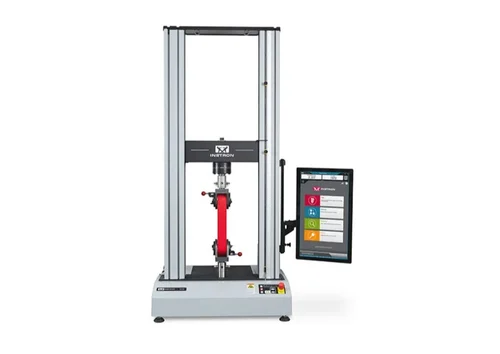
In simple words, flexural strength testing (also called the bend test or three-point / four-point bending test) measures how much bending force a material can take before it deforms or breaks. Imagine holding a ruler at both ends and pressing down in the middle — the point at which it snaps tells you its flexural strength.
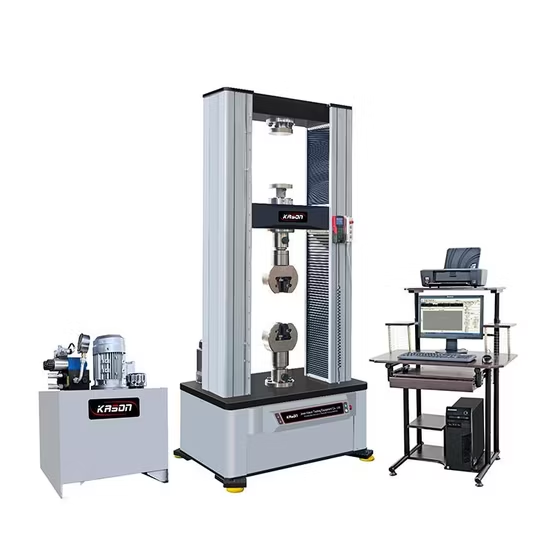
During the test, a specimen is placed on two support points, and a controlled load is applied at the centre (three-point bending) or at two points (four-point bending) using a Universal Testing Machine (UTM). The machine records exactly how the material behaves — how much it bends, how much load it resists, and when it finally fails.
From this single test, you get valuable data such as:
Materials rarely fail in a laboratory-perfect way in the real world. A dashboard panel in a car bends every time someone leans on it. A pipe carries weight from the soil above it. A circuit board flexes slightly during assembly. If these products haven’t been tested for bending resistance, you’re simply hoping they’ll survive — and hope is not a quality strategy.
Confirm every production batch meets your design specifications before it reaches the customer.
Compare different grades of plastics, composites, or alloys and choose the right one for your application.
Find out exactly why a component failed in the field and fix the root cause, not just the symptom.
It also helps with R&D validation, vendor approval, regulatory compliance, and customer documentation — all the things that keep your business credible and your products dependable.
Our flexural testing facility handles a wide range of materials and products, including:
| Material Category | Common Examples |
|---|---|
| Plastics & Polymers | ABS, PP, PVC, Nylon, HDPE, moulded components |
| Composites | FRP, GFRP, CFRP, laminates, sandwich panels |
| Metals | Steel, aluminium, welded joints, castings |
| Ceramics & Glass | Tiles, technical ceramics, refractory materials |
| Construction Materials | Concrete beams, mortar, bricks, pavers |
| Wood & Boards | Plywood, MDF, particle boards, laminates |
A test result is only as good as the standard behind it. At Kiyo R&D Lab, every flexural test is conducted strictly as per internationally recognised standards, so your reports are accepted by customers, auditors, and regulatory bodies worldwide. Commonly followed standards include:
Not sure which standard applies to your product? Don’t worry — our technical team will guide you to the right one based on your material and end-use.
Conveniently located in Chrompet, Chennai — easily accessible for clients across South Chennai, Tambaram, Pallavaram, and Guindy industrial belts.
Located in the heart of Oragadam, Chennai — Tamil Nadu’s automotive and manufacturing hub, perfect for OEMs and industrial suppliers nearby.
Great products are built on confidence, and flexural strength testing gives you exactly that — real data instead of guesswork. With ASTM & ISO standard testing, expert engineers, and two convenient labs at Chrompet and Oragadam, Kiyo R&D Lab is Chennai’s trusted partner for material testing.
Flexural strength testing measures how much bending force a material can withstand before it deforms or breaks. It’s important because most real-world products experience bending loads during use — and this test tells you whether your material can handle them safely.
We test plastics, polymers, composites (FRP, CFRP, GFRP), metals, ceramics, concrete, wood, plywood, and many finished components. If you’re unsure whether your material can be tested, just give us a call at 90420 86986.
We follow internationally recognised standards such as ASTM D790 and ISO 178 for plastics, ASTM D7264 for composites, ASTM C293/C78 for concrete, and ASTM E290 for metals. Our team will help you select the correct standard for your material and application.
In a three-point bend test, the load is applied at a single point in the centre of the specimen. In a four-point bend test, the load is applied at two points, creating a uniform stress zone between them. The right method depends on your material type and the standard being followed — our engineers will recommend the best fit.
Most flexural strength test reports are delivered quickly after sample submission, depending on the material and number of specimens. We understand production timelines, so we always prioritise fast and accurate turnaround.
We have two branches in Chennai — one at Chrompet (ideal for South Chennai, Tambaram, and Pallavaram areas) and one at Oragadam (perfect for industries in Chennai’s automotive and manufacturing corridor). You can choose whichever is more convenient.
You can drop your samples directly at our Chrompet or Oragadam lab, or courier them to us. Before sending, call 90420 86986 / 90876 86986 so our team can guide you on sample size, quantity, and preparation requirements.
Getting a quote is easy! Tap to call 90420 86986 / 90876 86986, visit www.kiyorndlab.com, or 💬 request a quote on WhatsApp and we will respond promptly with pricing and timelines.
We specialize in material and product testing, providing tailored solutions to meet each client’s unique needs.
For quotation or visit