
Most plastic and polymer failures don’t happen because the material was “weak.”
They happen because the material behaved differently under real operating conditions than expected.That’s exactly why dma mechanical analysis services in chennai – Kiyo R&D LAB exist.
A tensile test at room temperature won’t tell you how a plastic part behaves at 80 °C.
An impact test won’t explain why stiffness drops over time.
And a datasheet certainly won’t predict long-term viscoelastic behavior.
Dynamic Mechanical Analysis (DMA) is not a luxury test. It is a decision-making tool—used when you need to understand how materials truly respond to temperature, frequency, and load over time.
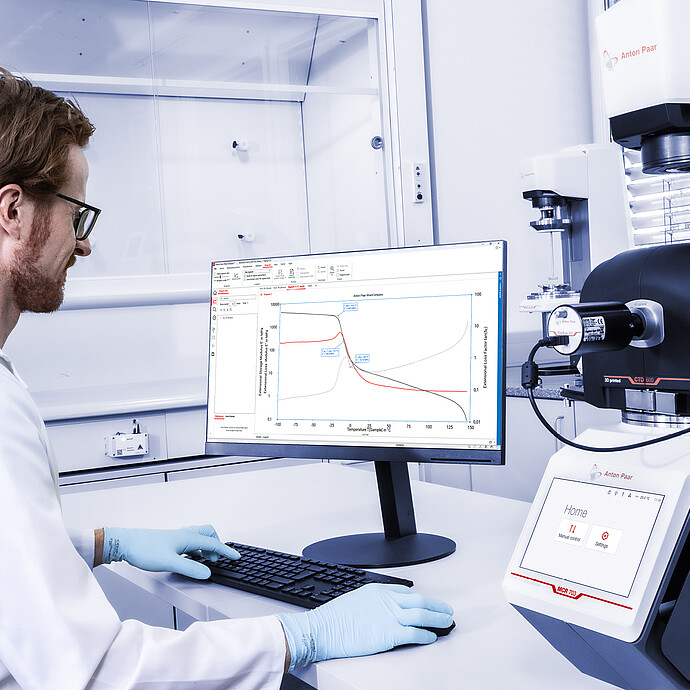
DMA (Dynamic Mechanical Analysis) measures how a material stores and dissipates energy when subjected to a small oscillating force. Instead of asking “How strong is this plastic?”, DMA asks more relevant questions:
These are the questions that standard mechanical tests cannot answer.
That’s why dma mechanical analysis services in chennai – Kiyo R&D LAB are widely used in:
Let’s be blunt.
Many manufacturers skip DMA because:
All three reasons are flawed.
Datasheet Tg values are generic averages, not process-specific.
Tensile and impact tests are static, not dynamic.
And DMA is often the only test that explains field failures caused by heat, vibration, or time-dependent deformation.
Ignoring DMA doesn’t save money—it just delays the problem.
At Kiyo R&D LAB, DMA is not treated as a lab demo test. It is handled as a controlled, application-driven analysis.
The focus is not just on generating curves—but on interpreting what those curves mean for real use conditions.
Before running DMA, Kiyo R&D LAB documents:
DMA without application context is just data.
DMA with context becomes insight.
DMA results are highly sensitive to specimen geometry.
Depending on the material and requirement, Kiyo R&D LAB selects:
Improper geometry = misleading results.
This is where inexperienced labs get it wrong.
This is the most commonly requested DMA test.
A controlled temperature ramp is applied while measuring:
This reveals:
For automotive and electrical parts, this data is often more valuable than tensile strength.
Materials behave differently at different loading speeds.
DMA frequency sweep tests help to:
This is critical for dashboards, trims, mounts, and rubber components.
Plastics and rubbers are viscoelastic, not purely elastic.
DMA helps evaluate:
This explains why a part that passed all initial tests may deform after months of use.
Here’s the uncomfortable truth:
If your product experiences heat + vibration + time, and you didn’t run DMA, you’re guessing.
DMA mechanical analysis services in chennai – Kiyo R&D LAB provide:
No other single test gives this depth.
DMA is especially powerful when:
Kiyo R&D LAB uses DMA curves to visually and numerically compare materials, making decisions data-driven rather than assumption-based.
DMA mechanical analysis services in chennai – Kiyo R&D LAB are ideal for:
If your material experiences real-world mechanical stress, DMA is not optional—it’s necessary.
DMA reports from Kiyo R&D LAB include:
The goal is not to confuse clients with curves—but to help them make confident material decisions.
Static tests tell you how a material behaves once.
DMA tells you how it behaves over time, temperature, and motion.
That difference matters.
DMA mechanical analysis services in chennai – Kiyo R&D LAB are designed for manufacturers who want clarity instead of assumptions, data instead of guesswork, and prevention instead of post-failure explanations.
If performance matters beyond room temperature and short-term loading, DMA is not an advanced option—it’s the correct one.