Your complete guide to DSC testing at Kiyo R&D Lab
When does a plastic melt, soften, crystallise, or finish curing? Those answers come from one of the most powerful tools in thermal analysis — DSC. It tracks the heat a material absorbs or releases as it’s warmed or cooled, revealing transitions you can’t see any other way. If you need reliable differential scanning calorimetry testing in chennai, Kiyo R&D Lab delivers precise DSC data that helps you identify materials, verify quality, and troubleshoot processing.
From plastics and polymers to pharmaceuticals, coatings, and composites, our expert team delivers accurate thermal transitions, supporting analysis, and clear, audit-ready reports you can rely on.
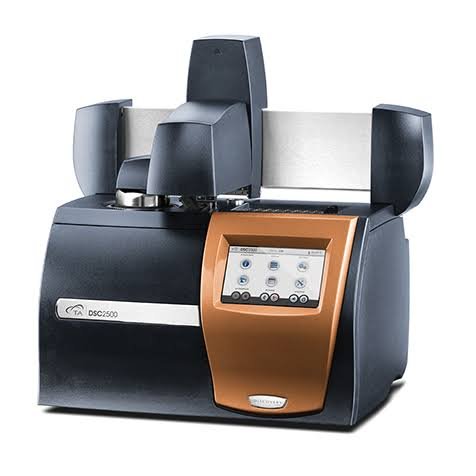
Differential Scanning Calorimetry measures the heat flow into or out of a sample as its temperature is changed, compared against a reference. When the material melts, crystallises, cures, or undergoes a glass transition, it absorbs or releases heat — and DSC records each event as a peak or step. Precise differential scanning calorimetry testing in chennai converts those thermal signatures into the numbers that identify and qualify a material.
For manufacturers, DSC confirms a polymer grade or cure state. For R&D, it guides formulation. For QC and failure work, it flags contamination, wrong material, or incomplete processing — all from a few milligrams of sample.
As a full-service provider of differential scanning calorimetry testing in chennai, we measure the key thermal transitions across plastics, pharmaceuticals, coatings, and composites.
Softening point of polymers.
Melt temperature & enthalpy.
Degree of crystallisation.
Curing of resins & thermosets.
Oxidative stability of polymers.
Fingerprint & purity checks.
| Transition | What It Shows | Why It Matters |
|---|---|---|
| Glass transition (Tg) | Step in heat flow | Service & softening limit |
| Melting (Tm) | Endothermic peak | Grade identification |
| Crystallisation | Exothermic peak | Processing behaviour |
| Cure | Reaction exotherm | Degree of cure |
| Oxidation (OIT) | Onset of oxidation | Stability & lifetime |
Our differential scanning calorimetry testing in chennai follows globally recognised methods so your reports are accepted by auditors, buyers, and regulators alike.
ASTM ISO
| Standard | What It Covers | Use |
|---|---|---|
| ASTM D3418 | Transition temperatures of polymers by DSC | Tg, Tm |
| ISO 11357 | Plastics — DSC (full series) | All transitions |
| ASTM E793 | Enthalpies of fusion & crystallisation | Enthalpy |
| ASTM D3895 | Oxidative induction time (OIT) | Stability |
| ISO 11357-6 | Oxidation induction by DSC | OIT |
Need weight-loss and composition data too? DSC pairs naturally with TGA — ask us to run both for a complete thermal profile.
Based in Chennai with branches in Chrompet and Oragadam, Kiyo R&D Lab makes professional DSC testing easy to access for the Chennai–Oragadam industrial corridor, with convenient drop-off and courier-friendly collection.
Looking for differential scanning calorimetry testing in chennai? Our facilities measure Tg, melting, crystallinity, cure, and OIT with quick turnaround and clear reporting.
📞 Call 90420 86986 💬 Request a QuoteExplore all our capabilities at www.kiyorndlab.com.
When material identity, quality, and processing depend on thermal behaviour, trust a lab that delivers clear answers. As a leading provider of differential scanning calorimetry testing in chennai, we combine precise instruments, recognised methods, and expert interpretation to give you data you can stand behind.
From a single Tg check to a full thermal characterisation, the team at Kiyo R&D Lab is ready to help. Reach out today and turn your sample into a reliable, audit-ready report.
We specialize in material and product testing, providing tailored solutions to meet each client’s unique needs.
For quotation or visit