Materials expand when heated and contract when cooled. Everyone learns this in textbooks. But in real products and real installations, thermal expansion is not a theory problem — it’s a failure problem.
Cracked pipes, warped plastic parts, misaligned assemblies, coating delamination, seal leakage, and dimensional rejection during inspection often trace back to one overlooked property: thermal expansion. That is exactly why Thermal Expansion testing services – Kiyo R&D LAB are critical for manufacturers and project teams that cannot afford surprises after installation or delivery.
At Kiyo R&D LAB, we don’t treat thermal expansion as a checkbox test. We evaluate how materials actually behave under temperature changes, using NABL-accredited testing, aligned with ASTM, ISO, and IS standards.
In real service conditions, materials are rarely at constant temperature. They face:
If thermal expansion is not properly evaluated, the result is predictable:
Thermal Expansion testing services – Kiyo R&D LAB help identify these risks early — before products fail in the field or get rejected during inspection.
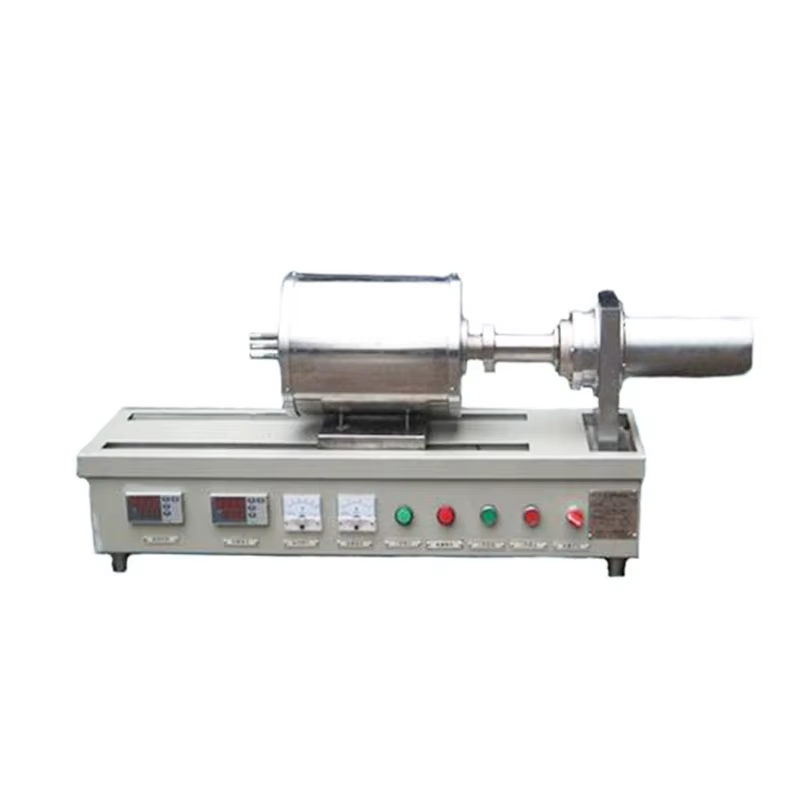
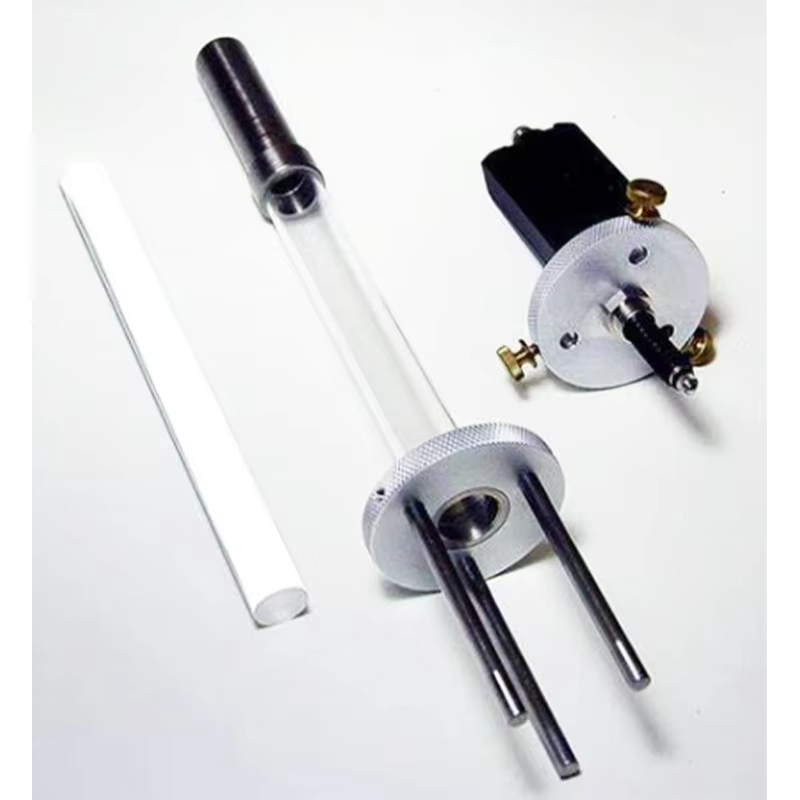
Thermal expansion testing measures how much a material’s dimensions change when temperature changes. But the real value lies in how that data is used.
At Kiyo R&D LAB, thermal expansion testing helps answer questions like:
We focus on engineering relevance, not just numerical output.
Thermal expansion testing is essential for a wide range of materials, including:
Different materials expand at different rates. When dissimilar materials are assembled together, uncontrolled expansion becomes a design risk.
That’s why Thermal Expansion testing services – Kiyo R&D LAB are often requested during product design, material selection, and failure analysis.
At Kiyo R&D LAB, thermal expansion testing is performed under controlled, NABL-accredited laboratory conditions with calibrated equipment and traceable procedures.
Our approach includes:
Testing is conducted as per applicable ASTM, ISO, and IS standards, depending on material type and application.
Design engineers often choose materials based on strength or cost alone. Thermal expansion data ensures that the material will maintain dimensional stability during use.
When two materials expand at different rates, joints become stress points. Thermal expansion testing helps prevent:
During molding, extrusion, coating, or curing, temperature variation can distort parts. Testing helps optimize:
Repeated heating and cooling cause fatigue. Thermal expansion testing helps predict long-term behavior, not just short-term performance.
Thermal Expansion testing services – Kiyo R&D LAB are commonly used by:
Any industry where dimensional accuracy matters needs thermal expansion data — whether they realize it or not.
Clients often approach us after facing:
Thermal expansion testing helps identify whether the issue is caused by:
This turns guesswork into engineering clarity.
Let’s be direct. Many labs can generate numbers. Very few help you understand what those numbers mean for your product.
We focus on decision-ready data, not just compliance.
Thermal expansion test reports from Kiyo R&D LAB are suitable for:
Every report is traceable, reproducible, and defensible.
Engage Thermal Expansion testing services – Kiyo R&D LAB when:
Testing early prevents expensive redesign and field failure later.
Thermal expansion is not a minor property. It is a root cause of many real-world failures when ignored.
Thermal Expansion testing services – Kiyo R&D LAB provide manufacturers, designers, and quality teams with accurate, NABL-accredited, and practically interpretable data — helping ensure dimensional stability, durability, and long-term performance.
If your product experiences temperature changes, don’t assume it will cope.
Test it. Understand it. Approve it.
That’s what we deliver at Kiyo R&D LAB.